


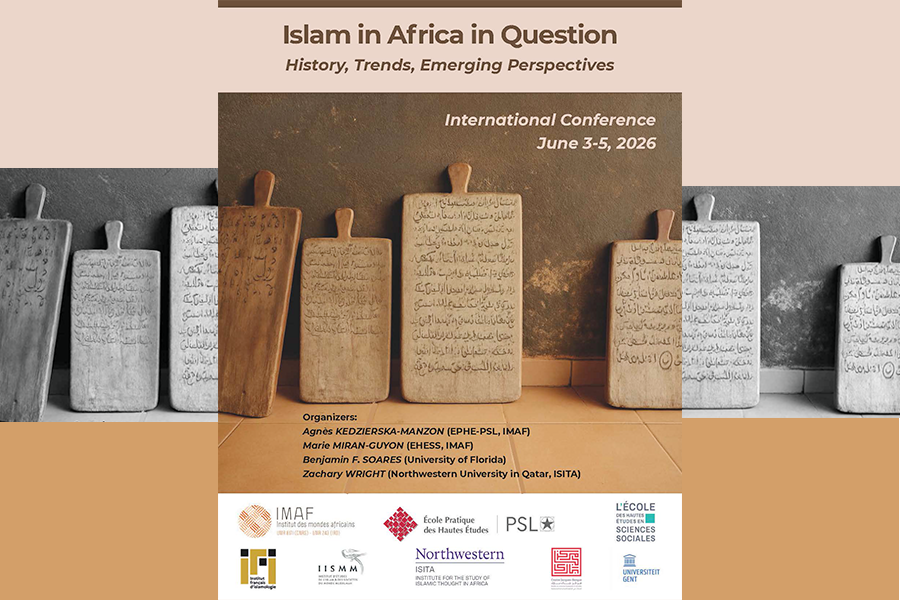
Conférence international : Islam in Africa in Question – History, Trends, Emerging Perspectives
juin 3 @ 14h30 - juin 4 @ 18h00
Islam in Africa in Question – History, Trends, Emerging Perspectives
International Conference
June 3-5, 2026
 |Programme |
Wednesday, June 3, 2026
École Pratique des Hautes Études (EPHE), Sorbonne
17 rue de la Sorbonne, 75005 Paris | Room Delamare (2 nd floor, staircase E)

Thursday, June 4, 2026
École Pratique des Hautes Études (EPHE), Sorbonne
17 rue de la Sorbonne, 75005 Paris | Room Delamare (2 nd floor, staircase E)
Since the early 2000s, the humanities and social sciences have played a major role in advancing the study of Islam and Muslim societies in Africa, both north and south of the
Sahara. Increasingly, the field of Islamic Africa has benefited from interdisciplinary dialogue between historians, anthropologists, archeologists, art historians, political scientists,
sociologists, and religious studies scholars.
This international conference has two major objectives. The first aims to revisit and renew historical approaches. Since 2000, notable attempts to synthesize the history of Islam and Muslim societies in Africa include Levtzion & Powell’s History of Islam in Africa and Robinson’s Muslim Societies in African History. One can also point to important case studies on early modern and modern Africa (too numerous to cite), as well as scholarship documenting and analyzing Africa’s Islamic textual traditions (e.g., John Hunwick’s oeuvre, Ousmane Kane, etc.).
More recently, many scholars have recognized the need for a greater synthesis that will show the state of the field and the achievements of this now established subfield. In the past
decade, Loimeier’s Muslim Societies in Africa and two “handbooks” (Palgrave & Routledge) have appeared.
Although valuable for the field’s consolidation, the current historical juncture is ripe for a more general authoritative reference work about the history of Islam in Africa. The
participants in the first panels of the conference will reflect critically on previous scholarship and attempts at synthesis in order to lay the ground for a new reference work on the topic that
would make it accessible to broader audiences and ensure such scholarship demands and commands attention. They will address thematic areas, including law/jurisprudence, gender, politics, religious encounters, Sufism, etc. in the early modern and modern periods throughout Africa.
The second objective of the conference is to engage with the wide-ranging multidisciplinary transformations in the field and to reflect on its innovative directions and future prospects. It
welcomes strategies to map and expand the influence of the “Islamic Africa” field into related fields of Islamic studies, the study of African religions, Indian Ocean studies, and Black studies. These open and critical reflections are intended, in part, to encourage discussion about the future of specialized publishing in the field—notably Islamic Africa and Islam et
Sociétés au sud du Sahara, both longstanding journals that have marked the field and which are currently experiencing renewal. The conference not only seeks to spark ideas for possible cooperation between these journals and other publishing ventures, but also to discuss future research collaborations between appropriate institutes. as an informal gathering, participants in the second half of the conference will be invited to give a brief oral presentation on their latest research or area of specialization, as well as their perspectives on the broader issues at stake, followed by extended discussion.
Possible guiding questions include: How might social science, historical, and philological approaches be more productively related to one another? To what extent should area studies, global perspectives, or comparative religions’ approaches be emphasized—or not? What kind of shared research agenda might be envisioned for the future in a plural and inclusive way?
The organizers expect that participants will arrive at some preliminary proposals concerning the editorial management and intellectual development of both journals, including potential special issue proposals, as well as broader shared research initiatives.
Organizers:
Agnès KEDZIERSKA-MANZON (EPHE-PSL, IMAF)
Marie MIRAN-GUYON (EHESS, IMAF)
Benjamin F. SOARES (University of Florida)
Zachary WRIGHT (Northwestern University in Qatar, ISITA)


